





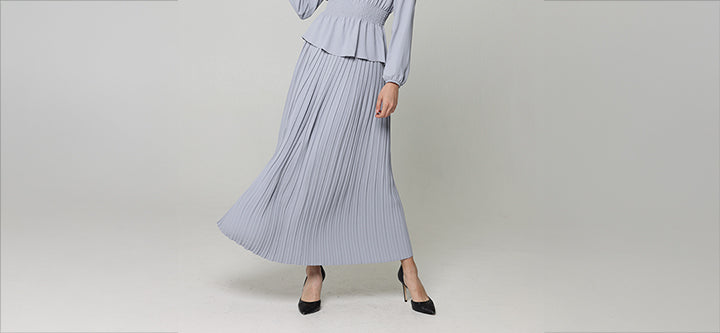


Open almost any modern wardrobe and you may find one: a long shirt worn over trousers, a loose embroidered top, a simple linen layer, or a flowing piece that falls somewhere between a blouse and a dress.
We call it a tunic.
It feels completely at home in contemporary fashion, particularly in a modest wardrobe. Yet the basic idea behind the tunic is thousands of years old. Versions of this wonderfully simple garment have appeared across civilizations, climates, religions, and social classes. From the ancient Mediterranean to Central Asia, Persia, the Arab world, South Asia, and eventually modern Western fashion, the tunic has been reinvented again and again.
Perhaps that is because its basic idea is so practical: take a comfortable piece of fabric, create room for the head and arms, and let the cloth fall naturally over the body.
Simple enough. And somehow, endlessly adaptable.

An Ancient Idea
There is no single moment when someone “invented” the tunic. Tunic-like garments developed in different parts of the ancient world, and the word itself comes to us through the Latin tunica.
In ancient Rome, the tunic was one of the fundamental garments of everyday life. Men and women wore versions of it, although length, decoration, fabric, and the garments worn with it could vary according to period, status, and occasion. For many Romans, it was essentially a basic layer of clothing, while the famous toga was a more formal outer garment associated with male Roman citizenship.
But Rome certainly did not have a monopoly on loose, straight-cut clothing.
Across the ancient Middle East and surrounding regions, people wore long shirts, robes, and tunic-like garments well suited to both the climate and the textile traditions of the area. The beauty of this basic shape was that it could be made from relatively straightforward pieces of cloth, while still leaving enormous room for variation.
And variation is where the story becomes interesting.
From Practical Garment to Canvas
A tunic can be simple, but it doesn't have to be plain.
As textile traditions became increasingly sophisticated, clothing became a place to display weaving, embroidery, pattern, color, and craftsmanship. A basic silhouette could become extraordinary through what was added to it.
Think of embroidery around a neckline, decorative borders at the cuffs, woven patterns, contrasting panels, beautiful buttons, or elaborate stitching.

Across the Islamic world, clothing traditions varied enormously from one region to another. There was never one universal “Islamic tunic.” Geography, local customs, available textiles, trade, wealth, and changing dynasties all influenced what people wore.
What these regions did share were extraordinary networks of exchange.
Muslim merchants and travelers moved through trade routes connecting the Mediterranean, Middle East, Africa, Central Asia, India, Southeast Asia, and beyond. Fabrics, dyes, motifs, techniques, and ideas traveled with them. A textile could cross borders much more easily than we sometimes imagine when looking at history through modern national boundaries.
Clothing has always been a traveler.
The Tunic Travels East
South Asia developed its own rich family of tunic-like garments, including the kurta and kameez, which remain part of everyday wardrobes today.

This is one reason the history of the tunic feels particularly relevant to modest fashion. In Pakistan, India, Bangladesh, and neighboring regions, the long shirt never became merely a historical costume displayed behind museum glass. It continued to evolve.
Lengths changed. Sleeves changed. Necklines changed. Trousers underneath became wider, narrower, straighter, or more flowing. Fabrics moved from practical everyday cottons to silk, chiffon, linen, and luxurious embroidered textiles.
Yet the basic silhouette survived.
A woman today might wear a long kameez with wide-leg trousers and sneakers, while her grandmother wore a different version of essentially the same clothing idea decades earlier.
That continuity fascinates me.
Fashion loves to tell us that everything must constantly be new, but some of the most successful designs in human history have survived precisely because they can change without losing their identity.
Why the Tunic Works So Well for Modest Dressing
The tunic solves several wardrobe problems at once.
It offers coverage without necessarily requiring heaviness. It can skim the body rather than cling to it. Depending on the cut, it works with straight trousers, wide-leg pants, skirts, or jeans. It can be casual enough for errands and elegant enough for dinner.
Most importantly, it allows modesty and personal style to coexist.

A tunic can be minimalist and architectural, soft and feminine, richly embroidered, boldly printed, or completely neutral. It can carry a traditional motif while being styled in a thoroughly contemporary way.
At Artizara, this meeting point between heritage and modern life has always interested us. A beautiful embroidered tunic does not have to be saved for Eid, a wedding, or a cultural celebration. Pair it with simple trousers and loafers and it becomes part of an ordinary Tuesday.
Heritage becomes much more meaningful when we actually live in it.
One Silhouette, Endless Personalities
Perhaps the tunic has lasted because it refuses to be just one thing.
Imagine a crisp white cotton tunic with navy trousers and sandals. Now imagine a jewel-toned embroidered tunic with flowing pants and gold jewelry. Then picture a long linen tunic worn open over a simple top, almost like a lightweight jacket.
They are related, but they tell completely different stories.
The same silhouette can move between cultures, generations, seasons, and occasions simply through changes in fabric, proportion, decoration, and styling.
It also makes the tunic particularly useful for women who live between cultures. You can wear something that quietly references South Asian, Middle Eastern, or Muslim dress traditions without feeling as though you are wearing a costume from another era.

That distinction matters.
Heritage clothing does not have to mean reproducing the past exactly. Sometimes honoring tradition means allowing it to continue evolving.
Perhaps the Tunic Was Never Really a Trend
Every few years, fashion announces the “return” of something that millions of people never stopped wearing.
Long shirts return. Layering returns. Embroidery returns. Loose silhouettes return.

And somewhere, a woman in Karachi, Cairo, Istanbul, London, Toronto, or California might reasonably wonder where they supposedly went.
The tunic reminds us that fashion history is much bigger than a sequence of Western runway trends. Clothing moves across borders. Cultures borrow from one another. Old silhouettes acquire new names. Practical garments become fashionable, fall out of fashion in one place, and remain completely ordinary somewhere else.
Through all of that change, the tunic keeps going.
Maybe its longevity comes down to something very simple. It gives us room to move. It gives us coverage. It gives artisans a canvas for beautiful work. And it gives each generation enough freedom to make the silhouette its own.
Thousands of years after humans first began wearing garments we would recognize as tunic-like, we are still reaching for them.
Not because fashion forgot to invent something better.
Perhaps because some ideas were good from the beginning.

Leave a comment